
Restaurant loyalty programme for delivery customers
Most restaurant groups do not have a delivery problem. They have a customer ownership problem.

A restaurant loyalty programme for delivery customers is what sits between those two realities. Aggregators are good at bringing people in. They are far less useful once that customer has already decided they like your food.
That distinction matters because discovery and repeat behaviour are not the same job. Uber Eats and Deliveroo can keep the top of the funnel moving. But if every second, third and fourth order still goes back through a marketplace, you keep paying discovery-level commission on customers you have already won. For a multi-site brand, that is not just expensive. It is structurally weak.
Why a restaurant loyalty programme for delivery customers matters
Most operators already know the headline problem. Commission eats margin. What gets missed is the compounding effect over time. If one customer orders from you eight times in six months and all eight orders come through an aggregator, the cost is not limited to one transaction fee. You are effectively renting the same customer back, again and again.
That changes how loyalty should be viewed. This is not a soft marketing add-on. It is a margin tool. It is also a customer data tool and a retention tool, but margin is usually where the case becomes obvious.
Take a simple example. A customer places a £24 delivery order. On a 30% commission model, roughly £7.20 disappears before the food cost, labour, rent and packaging have even been accounted for. If that same customer can be shifted to a direct ordering journey on their next few orders, the financial difference becomes material very quickly. Across multiple sites, it stops being a marketing idea and starts looking like an operating decision.
The point is not to stop using aggregators. For most growing restaurant brands, that would be unrealistic and commercially naïve. The point is to use them for what they do well, then build a route for repeat orders that you actually control.
What delivery loyalty usually gets wrong
A lot of restaurant loyalty schemes were built for dine-in behaviour and then awkwardly stretched over delivery. That is why many of them underperform.
A customer ordering to their flat on a Wednesday night is not behaving like someone collecting stamps on a coffee card or joining a generic points club at the till. Delivery is more habitual, more convenience-led and more price-sensitive. The loyalty mechanic has to reflect that.
The first mistake is making the reward too distant. If a customer needs ten or twelve orders before anything meaningful happens, most will stop paying attention. Delivery customers respond better when the value is visible and the path is short. That does not mean constant discounting. It means the incentive is clear enough to change behaviour.
The second mistake is treating loyalty as a bolt-on app feature instead of part of the ordering journey. If customers have to work hard to understand how they benefit, they will not bother. The reward needs to appear where the decision is made - when they are choosing where to order next.
The third mistake is ignoring the difference between acquisition and retention economics. If your loyalty model relies on discounting every order, you may increase frequency but damage profitability. The better approach is to give customers a reason to order direct without teaching them to wait for money off every time.
What a good restaurant loyalty programme for delivery customers looks like
A useful programme does three jobs at once. It encourages the second order direct. It gives customers a reason to stay direct. And it does this without creating an operational headache for site teams.
In practical terms, that usually means a branded direct ordering route paired with simple, visible rewards. Think less about gimmicks and more about behaviour shaping. A free side after a set number of direct orders can work. So can account credit, exclusive bundles, or order-based milestones that make sense against your average basket value. What matters is whether the reward nudges customers away from the aggregator after first discovery.
The best structure depends on the concept. A premium casual dining brand may not want to lead with discounting because it cheapens the proposition. A QSR group with high order frequency may benefit from a faster reward cycle. A family-focused takeaway concept may see better results with bundle-led incentives than points.
It depends on the customer pattern as much as the offer itself. If people order once a month, the reward has to stay memorable over a longer gap. If they order weekly, the programme can be tighter and more transactional. There is no universal template, but there is a universal principle. The easier it is for a customer to understand the value of ordering direct, the more likely they are to repeat outside the aggregator.
Loyalty only works if the customer can move channels
This is the operational piece many brands underestimate. You can design a sensible offer, but if there is no clean path from aggregator order to direct order, the programme has nowhere to do its job.
That handover matters more than the points logic. You need a practical way to capture the relationship once the customer has discovered you. Not with a clumsy hard sell, and not by pretending aggregators have no role. Just a clear route into your own branded ordering experience where loyalty can start to matter.
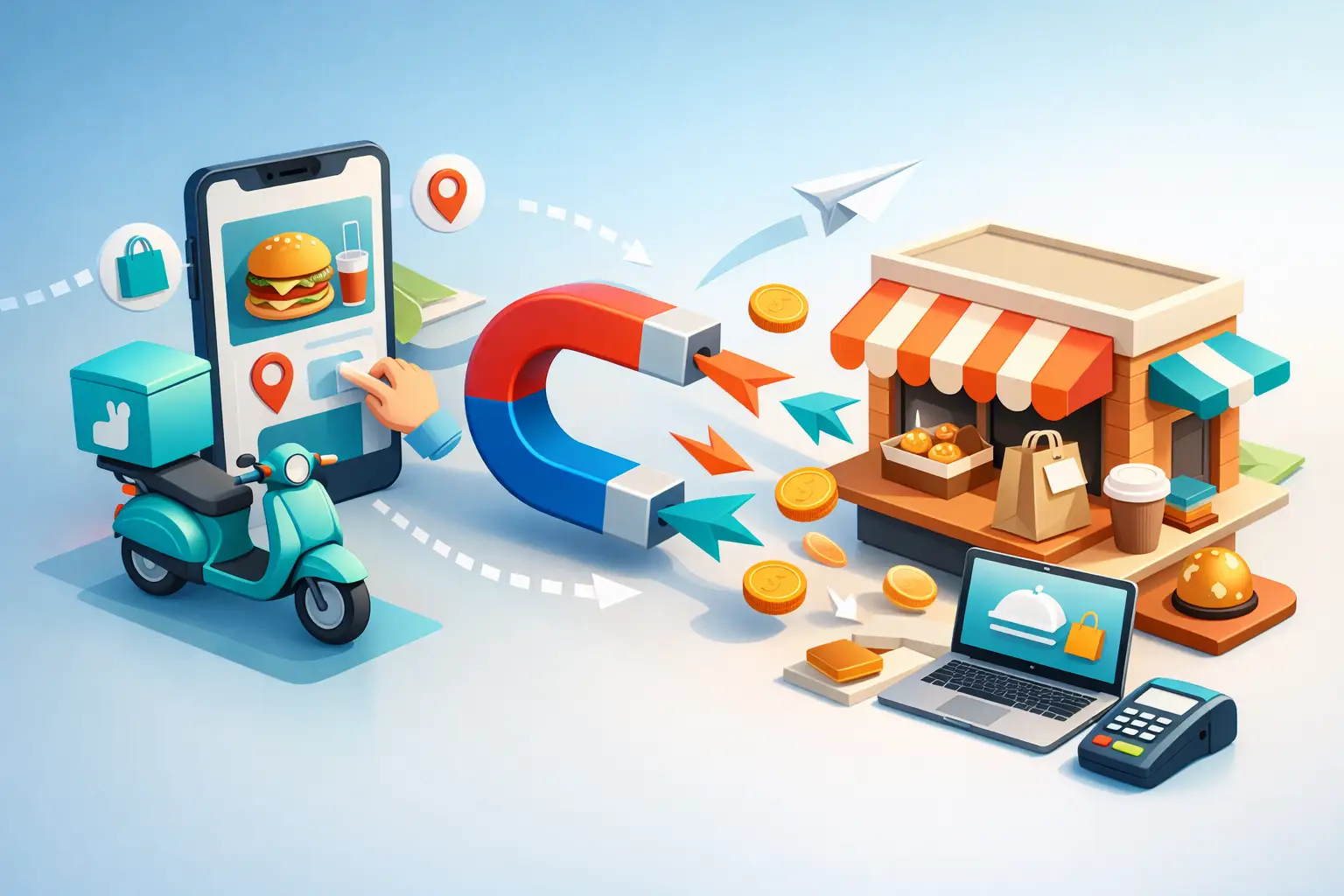
Once that route exists, the economics improve quickly. A customer acquired once through a marketplace can become a direct repeat customer with no commission on future orders. That is the shift that changes the model. It is not theoretical. It is the difference between accepting permanent dependency and building a more resilient revenue mix over time.
For multi-site operators, consistency matters here. If one site pushes direct ordering well and another does not, the results will be patchy. The loyalty programme needs to work across the estate without relying on individual managers to manually drive it every week.
How to judge whether your current setup is working
Most operators do not need another dashboard. They need a few honest numbers.
Start with repeat rate by channel. How many customers who first found you through an aggregator are still ordering there on order three or four? Then look at effective margin by channel, not just revenue by channel. If direct orders are materially more profitable, the next question is obvious: how well are you converting known customers out of the marketplace?
Then look at the shape of your reward model. Is it visible? Is it easy to explain? Does it create repeat direct behaviour, or does it simply subsidise customers who would have ordered anyway? Those are not the same thing.
There is also an operational test. Could a busy ops director explain the loyalty offer in one sentence? Could a customer understand it in five seconds? If not, it is probably too complicated.
Good delivery loyalty should feel commercially disciplined. It should not require constant promotion to stay alive. It should fit normal ordering behaviour and improve unit economics without creating friction at store level.
The real commercial case
For brands running 2 to 20 sites, this is where the conversation gets serious. A few percentage points of order mix moved from aggregator to direct can have a meaningful effect on site-level profitability. Not because direct suddenly fixes every margin issue, but because it removes one of the most avoidable costs from repeat orders.
That matters even more in a market where food inflation, labour pressure and rent are not easing in any meaningful way. Most operators do not have the luxury of giving 25% to 35% away on customers they could be retaining directly.
This is why the right loyalty setup is not anti-aggregator. It is simply disciplined. Marketplaces still perform the discovery role. They still bring reach. But once the customer knows your brand, the economics favour ownership.
That is the gap Carpia is built to address - sitting alongside aggregators, not replacing them, and giving restaurant groups a practical way to turn marketplace demand into direct repeat revenue.
The better question is not whether delivery customers should have a loyalty programme. It is whether you are comfortable paying acquisition-level costs forever for customers who already chose you once. If the answer is no, the next step is straightforward. Build a delivery journey that gives repeat customers a better reason to come back direct.
Insights
Insights that shape restaurants growth
Learn how restaurants use Carpia to drive direct orders and improve margins.