
How to Turn Deliveroo Customers Into Direct Orders
Most restaurant groups do not have a Deliveroo problem. They have a repeat-order problem.
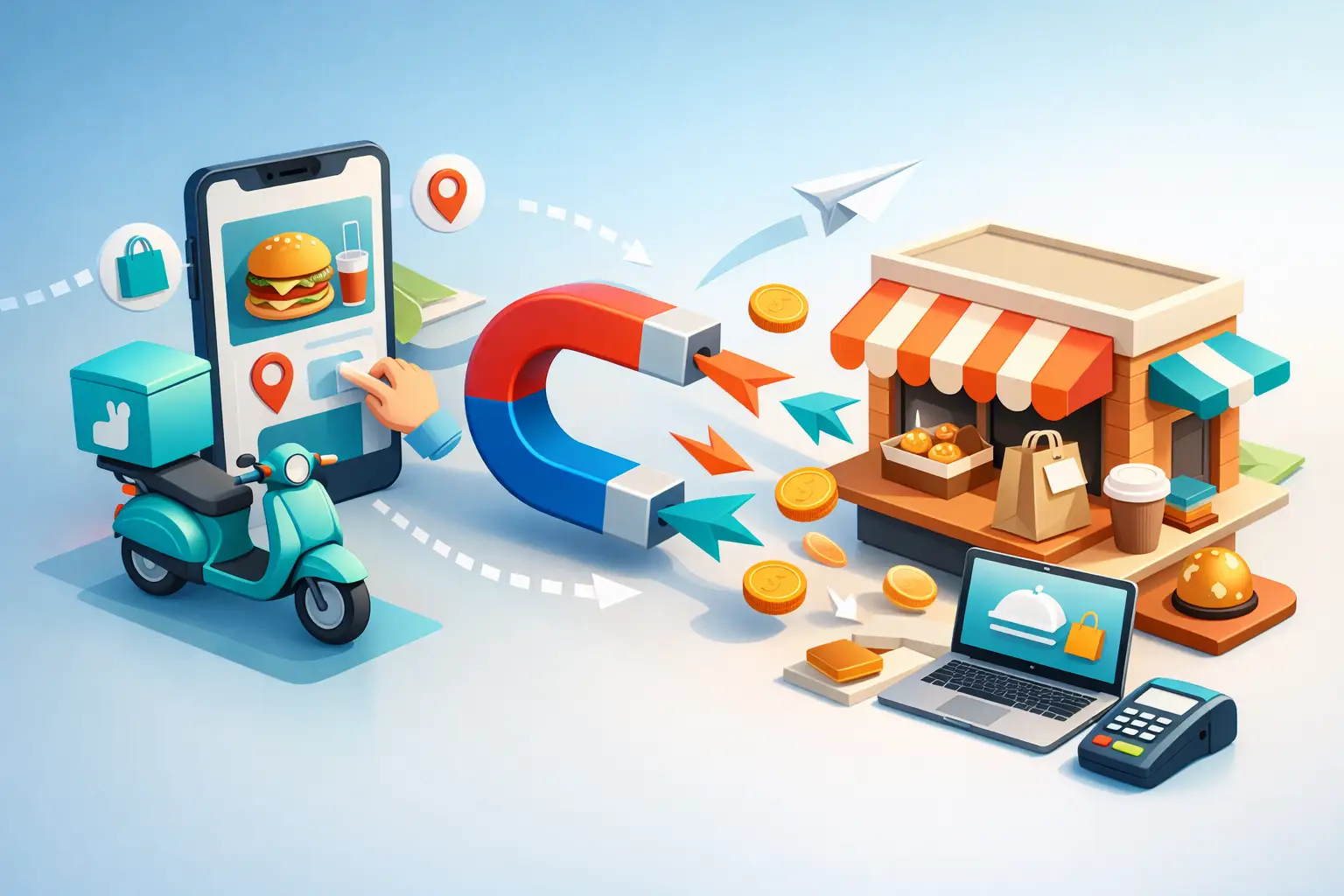
That is the right place to start if you want to understand how to turn Deliveroo customers into direct orders. Deliveroo is good at discovery. It puts your brand in front of customers who may never have found you otherwise. The issue is what happens next. If the second, third and fourth order still come through Deliveroo, you keep paying acquisition cost on a customer you have already won once.
That is where margins get squeezed. Not on the first order, which often has a clear purpose, but on every repeat order that stays inside the marketplace.
Why this matters more than most operators think
For a multi-site brand, this is not a marketing detail. It is a unit economics issue.
If a customer places a £28 order through Deliveroo and you are paying a meaningful commission, the cost is tolerable when Deliveroo has done the hard work of bringing that customer in. But if that same customer orders from you six more times over the next three months through the same channel, the commission is no longer a customer acquisition cost. It is an ongoing tax on demand you already created.
That is why the conversation should not be framed as direct versus aggregator. It should be framed as discovery versus ownership. Aggregators remain useful. They are good at generating first-time demand. But if you do not build a system to capture the relationship after that first order, you are renting your customer base indefinitely.
How to turn Deliveroo customers into direct orders without damaging volume
The mistake many operators make is trying to force customers out of Deliveroo too aggressively. They add clumsy leaflets, offer random discounts, or create a direct channel that is harder to use than the app the customer already knows.
That usually fails for a simple reason. Customers do not move channels because you want better margin. They move because the direct experience gives them a better reason to come back.
So the job is not to push. It is to make switching obvious and worthwhile.
Step one: accept Deliveroo's role
If your working assumption is that Deliveroo is the enemy, you will design the wrong strategy.
Deliveroo has reach, traffic and customer habit on its side. For many brands, it is still one of the most efficient ways to get discovered in a crowded urban market. The goal is not to replace that overnight. The goal is to let Deliveroo do the expensive part once, then make sure the next order is more likely to happen on your own terms.
That shift in mindset matters. It stops you chasing unrealistic channel migration targets and focuses the team on the part you can control: conversion after first purchase.
Step two: give customers a direct reason to reorder
Most direct-ordering propositions are weak. A slightly cheaper basket is not always enough. Nor is a vague message about supporting local restaurants. Customers respond to convenience, confidence and a clear benefit.
That benefit usually comes down to one of three things: better value over time, a smoother brand experience, or access to loyalty that does not exist on Deliveroo.
For most multi-site operators, loyalty is the strongest lever. Not because points are exciting in themselves, but because they create a repeat-order reason that compounds. If a customer knows their next direct order moves them closer to a free side, money-off reward or VIP perk, that is more persuasive than a one-off flyer discount that gets forgotten after the first use.
The key is consistency. The offer has to be simple enough to understand at a glance and strong enough to change behaviour. If customers need to decode it, it will not work.
The direct channel has to be operationally credible
This is where plenty of strategies fall apart.
Operators focus on the idea of direct ordering but underinvest in the actual customer journey. If the branded ordering flow is slow, confusing or clearly inferior to Deliveroo, conversion rates will stay low no matter how attractive the economics look on paper.
A credible direct channel needs a few basics. It has to work well on mobile. It has to make reordering easy. It has to reflect the brand properly. And it has to fit your existing kitchen and delivery workflow without creating operational friction at site level.
That last point matters more than most head-office teams expect. If managers and staff see direct orders as another awkward process to manage, execution slips quickly. If direct ordering sits cleanly alongside current delivery operations, adoption is far stronger.
Step three: use the order itself as the conversion moment
The best time to shift a customer from Deliveroo to direct is immediately after they have had a good experience with your food.
Not two weeks later. Not through a generic social post. Not through a half-hearted email they may never see.
The order is the moment when the customer is paying attention. They have chosen your brand. They are expecting a delivery. They are evaluating whether they would order again. That is when your packaging, inserts and post-order messaging need to do a clear job.
A simple message works best. Order direct next time. Get a better deal. Earn rewards. Keep it consistent across every site.
This is also where many brands overcomplicate things. You do not need ten promotional variants and a different message for every daypart. You need a single, commercially sensible reason to reorder direct and a system for presenting it every time.
What usually gets in the way
There are three common blockers.
The first is fear of losing marketplace sales. That fear is understandable, but it often leads to inaction. In reality, turning Deliveroo customers into direct orders is not about cutting off a revenue source. It is about improving the mix of future orders. Some customers will stay on Deliveroo. Some should. The goal is not 100 per cent migration. It is a steadily better margin profile over time.
The second blocker is fragmented execution across sites. A group may agree the strategy is sound, but if some locations include inserts, some do not, and some handle direct fulfilment poorly, results become patchy. Multi-site conversion needs central discipline.
The third is weak follow-through. Brands often launch direct ordering, announce it once, then assume customers will naturally switch. They usually will not. Channel behaviour changes through repetition. If you want customers to remember your direct option, they need to see it consistently and get rewarded for using it.
Measuring whether the strategy is actually working
If you are serious about reducing dependency, you need to track more than top-line delivery revenue.
The useful question is not whether Deliveroo orders are still coming in. They probably will be. The useful question is whether the proportion of repeat demand being captured directly is improving.
At a practical level, that means watching direct order volume, repeat rate, average order value and the effective margin difference between direct and aggregator orders. Over time, you should be able to see whether previously aggregator-led demand is creating owned, repeat behaviour.
This is also where flat-fee economics become attractive. If your direct ordering setup costs a predictable monthly amount per location, the upside is easy to understand. A relatively small number of migrated repeat orders can justify the cost quickly. Once that threshold is crossed, the margin improvement compounds.
For that reason, the conversation with site-level teams should stay commercial. Not digital transformation. Not channel innovation. Just a straightforward question: how many repeat orders do we need to shift before this meaningfully improves store contribution?
How to turn Deliveroo customers into direct orders at group level
For groups with 2 to 20 locations, the right model is usually central strategy with simple local execution.
Head office sets the offer, the branding, the direct channel, the loyalty mechanic and the operational standards. Sites then execute against a playbook that is hard to get wrong. That matters because site teams are already balancing labour, prep, service and delivery handoffs. If conversion to direct depends on perfect local improvisation, it will not scale.
This is where a platform built specifically for aggregator-to-direct conversion earns its place. Carpia, for example, is designed around a simple commercial reality: aggregators win discovery, but brands need to own the repeat relationship. A branded direct ordering ecosystem with built-in loyalty gives operators a practical route to move that second order away from commission and into an owned channel, without asking them to abandon Deliveroo altogether.
That is the model that makes sense for most operators. Keep the discovery engine. Capture the customer relationship. Improve margins on the orders that follow.
The brands that handle this well are not the ones trying to escape aggregators in one move. They are the ones treating each Deliveroo order as the start of a customer relationship, not the end of a transaction. That is where the real margin sits.
Insights
Insights that shape restaurants growth
Learn how restaurants use Carpia to drive direct orders and improve margins.