
Restaurant First Party Customer Data Matters
A customer orders from you on Deliveroo three times in a month. You fulfil every order well.

A customer orders from you on Deliveroo three times in a month. You fulfil every order well. The food lands hot, the packaging looks good, and the ratings stay strong. Yet from your side, that customer may as well be three separate strangers. That is the commercial problem restaurant first party customer data solves.
For multi-site brands, this is not a marketing nice-to-have. It is the difference between paying to reacquire the same customer again and again, or building repeat demand that comes back direct. Aggregators are good at discovery. They put your brand in front of people who may never have found you otherwise. But if the relationship stays on the marketplace, the economics stay on the marketplace too.
What restaurant first party customer data actually means
In plain terms, restaurant first party customer data is the information your business collects directly from customers through channels you control. That usually means your own ordering site or app, loyalty programme, email sign-up, SMS opt-in, or account-based checkout.
It is not just a list of names and phone numbers. The useful part is the behavioural picture around it. What they order. How often they order. Which site they order from. Whether they buy on Friday nights or weekday lunches. Whether they respond to a free item, a discount, or nothing at all.
That changes how you run the business. You stop treating demand as one big anonymous flow and start seeing where margin, frequency, and loyalty are actually coming from.
Why it matters more for multi-site operators
Single-site independents feel this pain. Multi-site groups feel it harder because the leakage scales with every location.
If one site loses repeat customers to aggregator dependency, that is frustrating. If ten sites do it, it becomes a structural margin issue. You can spend heavily on food quality, ops, packaging, and brand, then still hand the repeat relationship back to a third party after every order.
That is why customer ownership matters more once you have a few sites trading. Group operators need consistency. They need to know whether a customer in Clapham behaves like a customer in Bristol. They need to know which offers drive profitable repeat orders and which simply train customers to wait for a deal. They need reporting they can actually act on.
Without first party data, you are making those decisions with one eye closed.
The margin issue is not subtle
Most operators do not need a lecture on commission. They see it every month.
What is often missed is the compounding effect when the same customer keeps returning via an aggregator. The first order may be a fair trade. You pay for visibility and access to demand you did not generate yourself. By the fourth or fifth order, the equation looks different. At that point, you are not paying for discovery. You are paying rent on a customer who already knows your brand.
That is where restaurant first party customer data starts to matter commercially. Once a customer orders direct, you can retain the data, communicate with permission, and give them a reason to come back without sacrificing a chunk of every future transaction.
Even small shifts make a difference. If each site converts a modest share of repeat aggregator customers into direct customers, the annual margin gain can be meaningful. Not theoretical. Real money back into the P&L.
Data is only valuable if it changes behaviour
There is no prize for collecting data you never use. Plenty of restaurant brands have customer records sitting in disconnected systems while the business still runs on broad discounts and instinct.
Useful first party data should help you do three things. First, identify who is worth retaining. Second, give them a reason to return direct. Third, measure whether that behaviour is profitable.
That means focusing on practical signals. Recency. Frequency. Average basket value. Favourite daypart. Preferred location. Response to loyalty incentives. These are not abstract metrics. They tell you who is drifting, who is loyal, and where you are over-discounting.
A customer who orders every Tuesday and stops for two weeks needs a different prompt from a customer who ordered once at launch and disappeared. Treating both the same is how brands waste budget.
Why aggregator demand and first party data should work together
There is a lazy argument that restaurants should simply abandon aggregators and push everything direct. For most growing brands, that is not serious advice.
Aggregators still matter. They have customer traffic, search behaviour, and local visibility that individual brands would struggle to replicate at scale. They are often the front door.
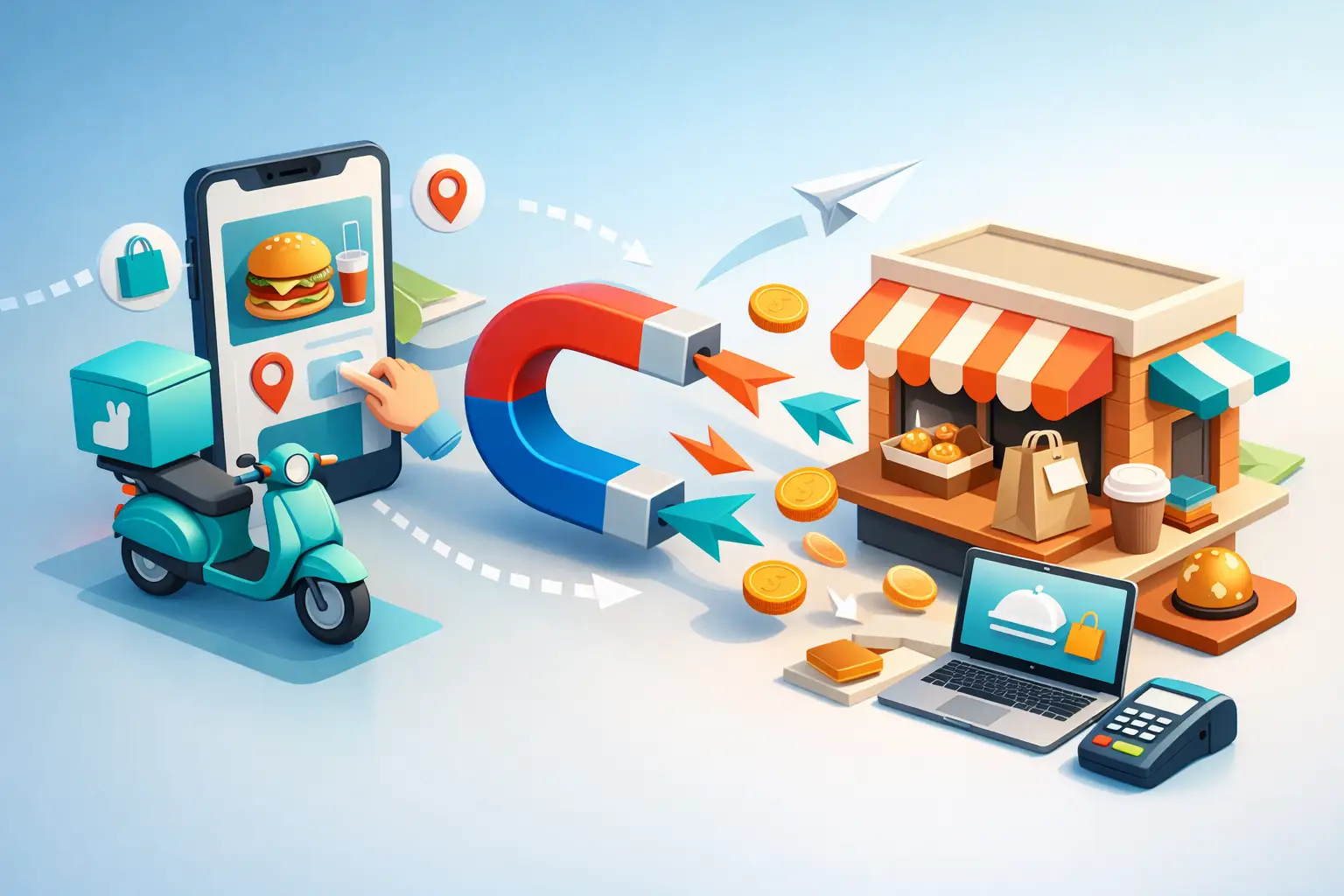
The smarter move is to use that front door properly. Let the aggregator do what it does well - discovery and convenience - then build a clear path into your own ecosystem for repeat business. That could be branded packaging, a bounceback offer, loyalty-led direct ordering, or a post-purchase incentive that makes the next order more attractive through your own channel.
That is not anti-aggregator. It is disciplined channel management.
How to build restaurant first party customer data without creating operational drag
This is where many strategies fall apart. On paper, everyone wants more direct customers. In practice, site teams are busy, systems are messy, and nobody wants another awkward process at the pass.
So the setup has to be simple. Your direct ordering journey needs to be branded, fast, and easy enough that customers will actually use it. Loyalty needs to be built in, not bolted on later. The data capture needs to happen as part of normal ordering behaviour, not through clunky forms that kill conversion.
Operationally, the best approaches tend to have three characteristics. They are easy for customers to understand, easy for managers to monitor, and easy for head office to measure across multiple sites.
There is also a trade-off here. The more data you ask for upfront, the more friction you create. Most brands are better off capturing the essentials first and building the customer profile over time through repeat interactions.
What good first party data lets you do next
Once you have a meaningful base of direct customers, the commercial options improve quickly.
You can reward frequency instead of blanket discounting. You can reactivate lapsed customers with a specific offer rather than a generic one. You can compare site performance based on customer quality, not just top-line sales. You can spot whether one location is driving bigger baskets but poorer retention, while another is building a stronger repeat base.
This is also where brand differentiation starts to return. On aggregator marketplaces, every restaurant is competing inside the same interface. Your imagery, pricing, and promo mechanics have limited room to breathe. In your own channel, you control the experience, the messaging, and the retention logic.
That control matters more than most operators think. Not because it feels good, but because it lets you build repeatable demand on your own terms.
The compliance point operators should not ignore
First party data is commercially useful, but it also needs handling properly. Permission, preference management, and clear communication matter. Bad data practices do not just create risk. They damage trust and reduce response rates.
For UK restaurant groups, that means being sensible about what you collect, why you collect it, and how you use it. Customers are generally happy to share data when the value exchange is obvious - faster checkout, loyalty rewards, relevant offers, easier reordering. They are less happy when data collection feels opportunistic or excessive.
The practical rule is simple. Ask for what you need. Use it intelligently. Give customers a reason to stay opted in.
Where most brands get this wrong
The common mistake is treating direct ordering as a side project rather than a channel strategy. A basic online ordering page on its own will not change much. Nor will occasional discount codes sent without any retention logic behind them.
If you want restaurant first party customer data to improve margins, it has to sit inside a wider commercial plan. How do customers move from discovery to direct? What makes the second direct order likely? Which incentives protect margin rather than erode it? How do site managers and head office know whether conversion is actually happening?
That is why the best operators do not frame this as a tech problem. They treat it as a repeat revenue problem.
For restaurant groups that rely heavily on aggregators, the goal is not to switch off marketplaces. It is to stop renting the same customer forever. If that sounds familiar, that is exactly the gap Carpia was built to close.
The useful question is not whether first party data matters. It is how much margin you are prepared to keep giving away before you build a way to own more of the repeat demand you have already paid to acquire.
Insights
Insights that shape restaurants growth
Learn how restaurants use Carpia to drive direct orders and improve margins.