
Branded Online Ordering for Restaurants
Most restaurant groups do not have a demand problem. They have a margin problem.
Orders are coming in. Delivery is established. Customers are clearly willing to buy. But when too much of that volume sits on marketplace apps, branded online ordering for restaurants stops being a nice-to-have and starts looking like basic commercial sense. The issue is not whether aggregators work. They do. The issue is what happens after the first order, and who owns the next ten.
For multi-site operators, that distinction matters more every quarter. Food costs move. Labour costs move. Rent rarely gets easier. If a growing share of revenue is also carrying commission, your sales line can rise while store-level economics stand still. That is why the conversation has shifted from pure acquisition to retention, from order volume to order quality, and from visibility to ownership.
Why branded online ordering for restaurants matters
Aggregators solved a real problem. They built consumer demand, created habit and made delivery mainstream. For many brands, they are still the fastest route to discovery in dense urban markets. Pretending otherwise is not serious.
But discovery and ownership are not the same thing. On an aggregator app, your brand is one tile among many. Your customer journey is constrained. Your pricing flexibility is limited by the competitive set around you. Most importantly, the customer relationship is not really yours.
That becomes expensive over time.
If a customer finds you on Uber Eats or Deliveroo and orders once, paying commission may be entirely rational. You are buying exposure. If that same customer orders from you six more times on the same channel, the economics look very different. At that point, you are no longer paying for discovery. You are paying repeatedly for a customer you already proved wanted your food.
This is the commercial case for branded ordering. Not ideology. Not channel conflict. Just maths.
The real value is in the second order
Operators often focus on the first-order CAC because it is visible. The deeper issue is repeat-order leakage.
A customer orders from your brand on a marketplace. They like the food. They are in your delivery radius. They are exactly the kind of customer you want to keep. Yet next time, they go back to the app, search again, compare you against a discounting competitor and place another commission-bearing order. Not because they prefer that model, but because that is where the habit sits.
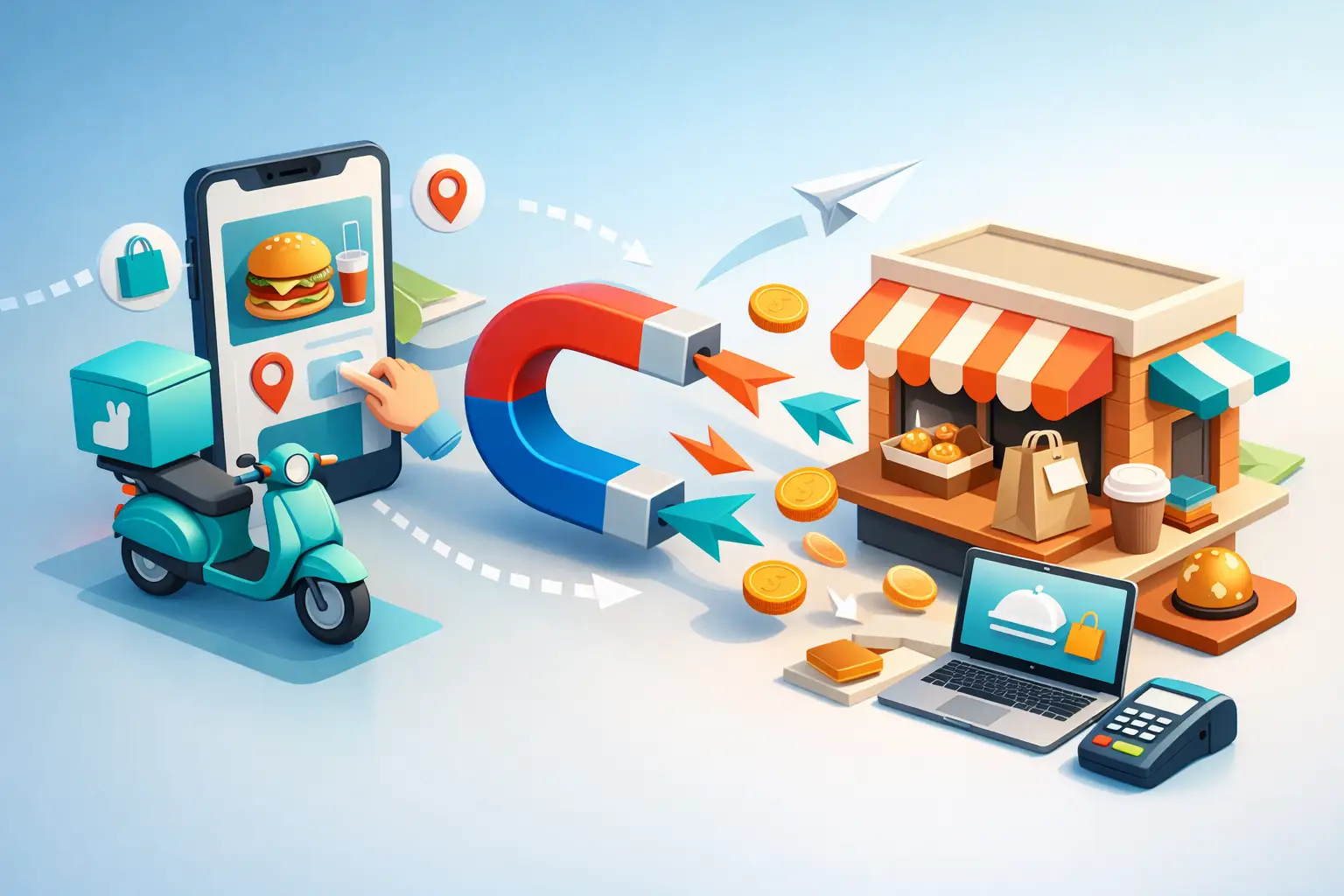
Branded online ordering for restaurants gives you a way to intercept that pattern. It creates a direct channel where the next order can happen on your terms, with your branding, your offers, your data capture and your retention logic. The goal is not to drag every customer off marketplaces overnight. The goal is to convert enough repeat demand into direct demand that unit economics improve meaningfully.
For a two-site group, that can be the difference between delivery being worthwhile and delivery being busy but diluted. For a ten-site group, small shifts in channel mix can translate into serious annual margin recovery.
What a branded ordering channel should actually do
A lot of operators hear "direct ordering" and think of a basic checkout page that sits quietly on the website and produces very little. That scepticism is fair, because many direct ordering tools have been built like software projects rather than commercial systems.
A proper branded channel needs to do more than process transactions. It needs to help convert marketplace-acquired demand into repeat direct behaviour. That means three things.
First, it needs to feel like the brand. Not a generic white-label experience that technically works but does nothing for differentiation. If the customer is moving away from a marketplace environment, they should land somewhere recognisably yours.
Second, it needs to fit the existing operation. Busy restaurant groups do not need another layer of admin or a new fulfilment headache. If direct ordering creates operational drag, it will not last, regardless of theoretical margin gain.
Third, it needs built-in retention mechanics. Loyalty matters here because customers rarely change habits on branding alone. They move when there is a clear reason to move, and they stay when repeat behaviour is rewarded consistently.
That is where many systems fall short. They launch a direct channel, then leave the operator to work out how to drive repeat usage. In practice, a branded ordering ecosystem without retention tools is only half built.
Margin improvement is only part of the picture
Commission savings get the attention because they are easy to understand. If an order shifts from a high-commission marketplace channel to a direct channel, the gross economics improve. That part is obvious.
Less obvious, but often more valuable, is the control that comes with customer ownership.
When you own the ordering relationship, you can see who is ordering, how often, from which site, at what basket value and with what cadence. You can shape offers around actual customer behaviour rather than broad assumptions. You can bring lapsed customers back. You can reward your best ones without discounting everyone. You can also build consistency across sites instead of relying on the marketplace to mediate the relationship.
This matters more for multi-site brands than independents. Once you are managing several locations, inconsistency compounds quickly. So does lost visibility. A direct ordering estate gives group operators a cleaner way to understand delivery demand across the business and influence it.
Where operators get this wrong
The biggest mistake is treating direct ordering as a replacement strategy rather than a conversion strategy.
If you frame the choice as aggregators versus direct, you create a false decision. Most sensible operators are not going to walk away from channels that generate discovery and demand. Nor should they. The better model is to let aggregators do what they are good at, then use your own branded channel to retain the customers worth keeping.
The second mistake is expecting instant migration. Customers do not switch channels because a restaurant would prefer them to. They switch because the experience is simple and the value exchange is clear. That may mean loyalty, better menu control, direct offers or just a more recognisable relationship with the brand.
The third mistake is underestimating execution. If the direct channel is hard to find, awkward to use or poorly signposted in-store and in-pack, adoption will be weak. This is not a website exercise. It is an operational one.
How to assess branded online ordering for restaurants
For operators considering a move, the right question is not "Do we need direct ordering?" It is "Can we convert enough repeat marketplace demand into direct demand to improve store-level economics without adding complexity?"
That shifts the evaluation in a useful way.
Look at how much of your delivery volume is likely to be repeat custom rather than true first-time discovery. Look at average order value, frequency and commission exposure. Then ask what happens if even a modest share of that volume moves direct over six to twelve months.
You do not need heroic assumptions. A practical model is enough. If a location is doing steady marketplace volume, and a portion of those customers can be retained directly, the savings stack up surprisingly quickly. Especially when the cost of the direct channel is predictable.
That predictability matters. Restaurant operators do not need another variable-cost tool that scales expense with success. A flat monthly fee is easier to plan around and easier to judge against recovered margin.
This is why the commercial framing matters more than the technical one. The question is not whether the platform has endless features. The question is whether it helps your brand keep more of the value it already creates.
For multi-site groups, that is where a system like Carpia fits. Not as a rejection of marketplaces, but as the layer that turns marketplace demand into owned repeat revenue.
The brands that benefit most
Not every restaurant has the same need.
If your delivery volume is minimal, or highly occasional, branded ordering may not move the numbers enough yet. If your customer base is almost entirely walk-in and local, the case may be weaker. It depends on channel mix.
But if you are running between two and twenty sites, doing meaningful marketplace volume and seeing delivery as an established part of the business, the upside is usually clearer. The more repeat demand you already have sitting on aggregator channels, the more room there is to improve economics by redirecting habit over time.
That is particularly true for brands with strong customer affinity but weak customer ownership. In other words, people know you, like you and come back, but they are still doing it through someone else's app.
That is fixable.
The smart operators are not trying to win an argument about channels. They are making a calmer calculation. Keep using aggregators for reach. Build a branded route for repeat business. Reduce commission dependency gradually. Improve margin without shrinking demand.
That is a much more useful way to think about delivery growth in 2026 and beyond.
If your group is already generating the orders, the next commercial step is simple: make sure more of the repeat ones belong to you.
Insights
Insights that shape restaurants growth
Learn how restaurants use Carpia to drive direct orders and improve margins.