
7 Ways to Reduce Uber Eats Commission Costs
Most operators ask the wrong question. They ask how to negotiate Uber Eats down by a few points.

Most operators ask the wrong question. They ask how to negotiate Uber Eats down by a few points. The better question is how to reduce Uber Eats commission costs without cutting off a channel that still brings in demand.
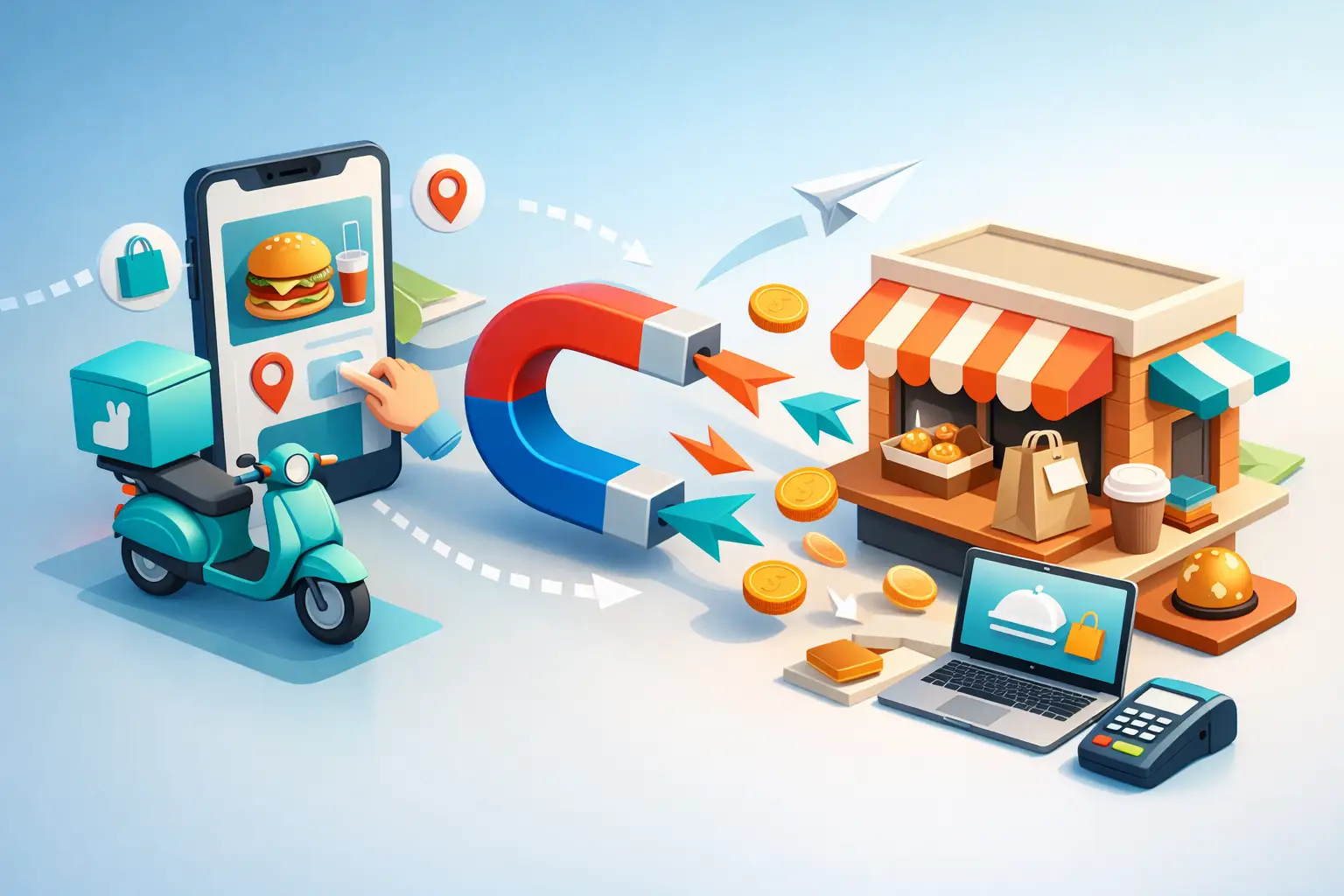
That distinction matters. Uber Eats is good at discovery. It puts your brand in front of customers who were not coming to your own site anyway. The problem starts when discovery turns into dependency. If too much of your delivery mix stays on the app, you are not just paying commission on acquisition. You are paying it again and again on repeat behaviour that should already belong to you.
For multi-site brands, that is where margin pressure builds. A single site can absorb a few inefficient orders here and there. Across five, ten or fifteen locations, the numbers stack up quickly.
What actually drives Uber Eats commission costs
Commission is only part of the cost. Most operators know the headline percentage, but that is not the full commercial picture. You also need to account for VAT treatment, promo funding, refund leakage, menu price tension and the fact that marketplace customers are not really yours.
If an order comes through Uber Eats at 30% commission, that is obvious. What is less obvious is what happens when that same customer orders six more times through the platform over the next three months. At that point, you have not paid for discovery once. You have paid repeatedly for access to the same person.
This is why the cleanest way to reduce commission costs is not simply to haggle over rates. It is to change the mix of where repeat orders happen.
1. Stop treating all aggregator orders as equal
A first-time marketplace order and a fifth marketplace order should not be viewed the same way. The first one may be commercially sensible. Uber Eats did the work of putting your brand in front of the customer. The fifth one is much harder to justify.
Operators who manage this well separate acquisition from retention in their thinking. They accept the cost of discovery, then build a plan to move repeat customers into an owned channel. That changes the economics immediately. You are no longer trying to eliminate aggregators. You are using them for the job they are best at, then keeping the higher-margin repeat business for yourself.
For a brand doing meaningful volume, that shift matters more than a small reduction in headline commission.
2. Be disciplined with menu pricing on Uber Eats
Many brands underprice on aggregators because they are worried about conversion. That instinct is understandable, but it often means subsidising a high-cost channel with your best margin.
If your direct and in-store pricing is built around one cost structure, and Uber Eats adds a completely different one, the maths has to reflect that. The question is not whether customers prefer lower prices. Of course they do. The question is whether your current pricing still leaves enough contribution after commission, packaging and labour.
There is a trade-off here. Push prices too far and conversion can soften. Hold them flat and you may be selling volume that looks healthy on paper but contributes very little. The right answer depends on cuisine, local competition and basket size, but the principle is the same: marketplace pricing should be intentional, not inherited.
3. Cut promo spend that is masking weak economics
Discounting on Uber Eats can create the illusion of demand. Orders rise, dashboards look busy and a promotion appears to be working. Then you strip out commission and funded discounts and realise you paid a lot to drive low-quality volume.
Promotions have a role. They can help with launch periods, quieter dayparts or market entry. But if discounting becomes permanent, you are not building a stronger delivery business. You are training customers to buy only when margin disappears.
A useful test is simple. If you removed the offer tomorrow, would enough customers still order because they actively want your food? If the answer is no, then the problem is probably not exposure. It is either proposition, positioning or retention.
4. Improve your direct channel before you push customers to it
Some operators talk about direct ordering as if putting a web page live solves the problem. It does not. If the experience is clunky, if the brand feels generic, or if the offer is no better than Uber Eats, customers will stay where they already are.
To reduce Uber Eats commission costs over time, your direct channel has to earn the repeat order. That means clean ordering journeys, clear branding, easy payment, reliable fulfilment and a reason to come back. Usually that reason is a better value exchange rather than a dramatic one-off discount. Loyalty, exclusive bundles or simple repeat-order incentives tend to hold up better than broad price cutting.
This is where many restaurant groups miss the opportunity. They know aggregator commission is expensive, but they do not build a serious alternative. Then they conclude that customers only want marketplaces. In reality, customers want convenience. If your direct channel delivers that, a meaningful share will move.
5. Use delivery inserts and packaging with intent
This is not glamorous, but it works when done properly. Every Uber Eats order that leaves your kitchen is a chance to start a direct relationship. Most brands waste it.
A generic flyer with no clear offer rarely changes behaviour. A thoughtful insert can. The key is to make the next step obvious and commercially sensible. Give the customer a reason to place their second or third order direct, not just a vague brand message.
Again, nuance matters. If your direct proposition is weak, packaging inserts will underperform. If your repeat incentive is sensible and your ordering journey is straightforward, inserts become a practical conversion tool. Across multiple sites and hundreds of weekly delivery orders, even a modest shift in customer behaviour can produce a meaningful margin gain.
6. Measure repeat order migration, not just total delivery sales
A lot of operators say they want lower commission dependency, but they still judge performance mainly on total delivery revenue. That can be misleading.
If delivery sales are flat but the share of direct repeat orders is rising, the business may actually be improving. You are keeping more gross profit per order and building customer ownership at the same time. If marketplace sales are rising but direct remains weak, you may just be increasing your exposure to a costly channel.
For group operators, the useful numbers are straightforward: repeat rate, direct share of delivery, average order value by channel and contribution after commission. Once you look at those consistently, commission dependency stops being an abstract concern and becomes a trackable operating metric.
7. Build a system, not a campaign, to reduce Uber Eats commission costs
This is where the real change happens. Reducing commission costs is not a one-off project. It is an operating model.
The strongest brands do not panic about aggregators and they do not try to switch them off. They use them deliberately. Marketplace apps bring in new customers. The brand then captures the repeat relationship through direct ordering and loyalty. Over time, that changes the mix of revenue and improves unit economics without sacrificing reach.
For a two-site business, that may start with getting one direct ordering flow right and making sure every delivery order carries a clear invitation back. For a ten-site group, it usually means standardising that approach across locations so repeat behaviour compounds. The point is consistency. If you rely on occasional discounts or ad hoc initiatives, the results will be patchy.
Where operators usually get this wrong
The biggest mistake is assuming the answer sits entirely inside Uber Eats. Better terms help if you can get them. Smarter menu engineering helps as well. But neither addresses the underlying issue, which is repeated commission on customers you do not own.
The second mistake is swinging too far the other way and trying to abandon aggregators altogether. For most urban restaurant brands, that is not realistic. They still matter for discovery, especially in competitive catchments where customers browse marketplaces before making a choice.
The commercially sensible position sits in the middle. Keep the discovery engine. Reduce the dependency. Make repeat orders cheaper to serve and more valuable to retain.
That is why more operators are focusing less on whether aggregator commission is fair and more on whether their business has a credible path away from paying it forever. If you can convert even a modest share of app customers into direct, repeat customers, the economics improve fast. For brands that want to do that without rebuilding the whole stack themselves, Carpia exists for exactly that reason.
A useful test for the months ahead is simple: if Uber Eats keeps bringing you new customers, do you have a reliable way to make sure their next order is more profitable than their first?
Insights
Insights that shape restaurants growth
Learn how restaurants use Carpia to drive direct orders and improve margins.